

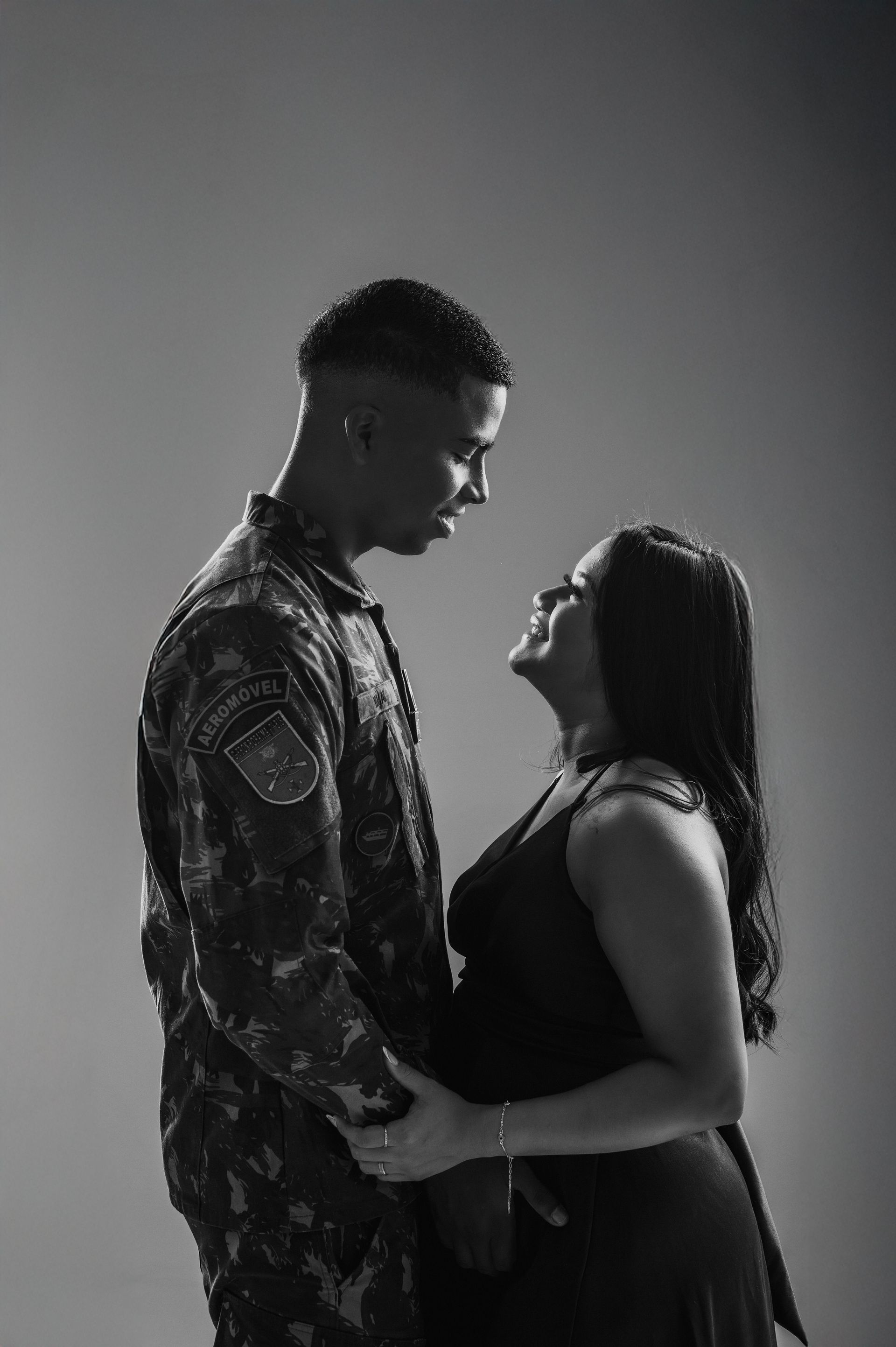
Military relationships are asked to do something most relationships never are: stay close across distance, absorb repeated upheaval, and reorganize themselves around a mission that doesn't negotiate. Couples who manage this are doing genuinely hard work, often without much recognition of how hard it actually is. The strain that shows up in these relationships usually isn't a sign of weakness or incompatibility. It's the predictable result of a demanding life, and it responds well to the right kind of help.
The stressors are real and specific
It helps to name what military couples are actually navigating, because the pressures are particular. There's the obvious one, separation, but the harder parts are often the transitions around it. The weeks before a deployment, when one partner is already pulling away to prepare and the other feels them leaving early. The reunion that was supposed to be pure relief and instead feels awkward, like learning each other again. The frequent moves that uproot the non-military partner's career and friendships over and over. The permanent low hum of uncertainty about where you'll be and when. Add the ordinary load every couple carries: money, parenting, intimacy, in-laws, and it's a lot of weight on one relationship.
Deployment and reintegration
Separation tends to get the attention, but reintegration is frequently the harder phase. While one partner was deployed, both adapted. The one at home built new routines, made decisions alone, and became more independent out of necessity. The one deployed lived in a sharpened, mission-focused world with its own rhythm and rules. Coming back together means two people who each changed trying to merge two systems that no longer fit automatically. Roles get tangled: who handles what now? Decisions that one person got used to making solo suddenly need two votes again. It can feel, confusingly, like friction with someone you were desperate to get back to. That's normal, and it's workable.
Operational stress and the shutdown that follows
There's also the matter of what operational stress does to a person's capacity to connect. The same emotional control that's essential in the field: staying flat, staying functional, not letting feeling interfere with the job, doesn't switch off at the door. It comes home. A partner may want to reconnect and find that the other has gone quiet and unreachable, not out of indifference but because that's the setting the nervous system got stuck in. The partner on the receiving end often reads this as rejection, and a painful cycle starts: one reaches, one withdraws, both feel alone. Understanding the mechanism behind the shutdown is usually the first step to interrupting it.
How Gottman-trained therapy meets these patterns
The Gottman Method doesn't ask couples to simply talk it out and hope. It gives both partners a shared language for what's happening, including the reach-and-withdraw cycle, and concrete tools to do something different. It teaches how to make and respond to small attempts at connection, how to repair after conflict instead of letting it calcify, and how to stay present in a hard conversation rather than flooding and going silent. For couples whose patterns were shaped by stress and distance, having an actual framework, not just sympathy, tends to land. It treats both partners as capable adults learning a skill, which is exactly what they are.
Why telehealth fits military life
The practical reality is that military families move, deploy, and live on schedules that don't bend for a standing weekly appointment across town. Telehealth removes that barrier. Sessions happen wherever you are: different bases, different states, sometimes different countries when connectivity allows, and they can follow you through a PCS instead of ending with one. Because consistency is one of the strongest predictors of whether couples therapy works, a format that survives the chaos of military life isn't a compromise. It's an advantage.
There's also a quieter benefit. Many service members are wary of where their mental health records live and who might see them, and the friction of sitting in a local waiting room can be enough to keep a couple from ever starting. Doing the work privately, from your own space, on your own schedule, lowers that barrier considerably. The goal is simply to make it easier to get good help and keep getting it, which, for a population that has more reasons than most to put it off, matters a great deal.
Your Way Therapy works with military and veteran couples across Virginia and beyond. Learn more.